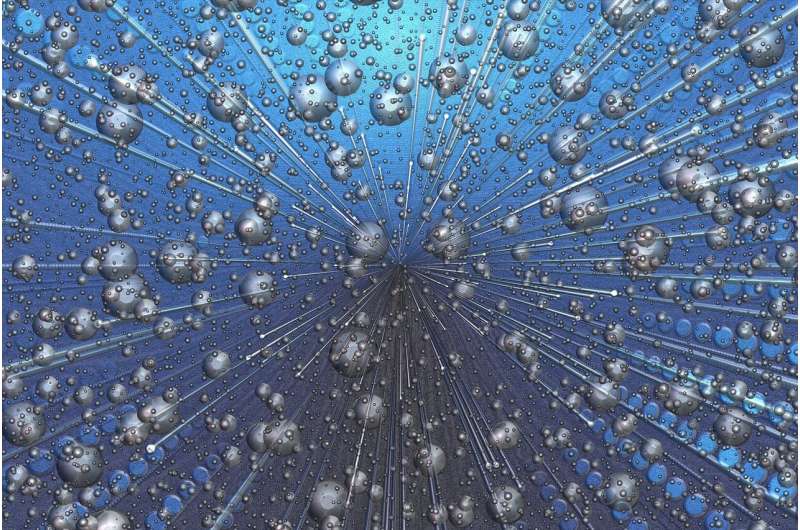
At the International Conference on High Energy Physics in Brazil, the BESIII Collaboration report that, after 15 years of sustained research, it identified the dominant constituent of the X(2370) as a pseudoscalar glueball with spin-parity quantum numbers of 0⁻⁺.
The strong interaction force tightly binds quarks inside protons and neutrons. Its mediator is called the gluon, just as the photon mediates the electromagnetic interaction. Notably, however, gluons can attract each other and form an entirely new particle—a bound state called a glueball.
The glueball is an important prediction of quantum chromodynamics, the theory that describes the strong interaction, and is also the only type of particle in nature composed entirely of force mediators. No particle of this kind has ever been observed experimentally, and its existence constitutes a crucial test of quantum chromodynamics.
Experimental searches for glueballs have continued for half a century and remain one of the major unresolved scientific questions. The Beijing Electron Positron Collider can produce large numbers of J/ψ particles; their decays provide one of the best avenues to search for glueballs. Searching for glueballs has been one of the collider's primary physics goals for decades.
The BESIII Collaboration discovered a new particle in J/ψ decays, called the X(2370), in 2011. Following another 13 years of work, the collaboration used a much larger sample of 10 billion J/ψ particles in 2024 to determine its spin-parity quantum numbers for the first time as 0⁻⁺. Its mass and quantum numbers are in complete agreement with predictions from lattice quantum chromodynamics for a pseudoscalar glueball (whose spin-parity is 0⁻⁺), marking a crucial step toward establishing its true identity.
Recently, the BESIII Collaboration discovered several new decay modes of the X(2370) and, in particular, determined for the first time its "flavor-singlet" nature, the most important characteristic of a glueball. This series of BESIII studies established a complete chain of experimental evidence: A pseudoscalar-glueball component must dominate the X(2370).
This is the clearest experimental result from nearly 50 years of searches for glueballs, verifying the major theoretical prediction that gluons can bind together to form a new type of matter. This result demonstrated the unique advantages of the Beijing Electron Positron Collider in studies of strong interactions.
Why is this discovery important?
The discovery of the glueball is a direct test of the non-Abelian gauge structure of quantum chromodynamics (QCD). While the discovery of asymptotic freedom established the foundation of QCD as the correct theory, the existence of the glueball provides decisive validation of the theory at low energies. Glueballs also represent an entirely new form of matter—matter composed of force mediators.
Who's behind this story?

BSc Life Sciences & Ecology. Microbiology lab background with pharmaceutical news experience in oil, gas, and renewable industries. Full profile →

Bachelor's in mathematical biology, Master's in creative writing. Well-traveled with unique perspectives on science and language. Full profile →
Citation: X(2370) emerges as glueball-dominated particle in collider experiments (2026, August 6) retrieved 6 August 2026 from https://phys.org/news/2026-08-x2370-emerges-glueball-dominated-particle.html
This document is subject to copyright. Apart from any fair dealing for the purpose of private study or research, no part may be reproduced without the written permission. The content is provided for information purposes only.