Key events
1h ago
That's all for now!
2h ago
Will Angie Nixon get the campaign money from her opponent who lost?
2h ago
Can AI take on the complex process of recouping investor debt?
2h ago
Can we trace where political spending ends up?
2h ago
How much of a role is crypto playing in the midterms?
2h ago
Can Republicans’ spending overcome their unpopularity?
2h ago
Will the Save Act have any influence in November?
2h ago
How likely is it that California’s billionaire tax will pass?
3h ago
What does money from a Super PAC actually buy?
20h ago
Welcome to the conversation
That's all for now!
Thanks, everyone, for reading and submitting questions. There’s still a few more weeks left until the 3 November elections, and you can expect us to be back before then for more of these sorts of conversation on the range of issues that will impact the outcome of the battle for control of Congress and state governments for the final two years of Donald Trump’s presidency.
We’ll also be talking to voters and elected officials across the country in the time left before the vote. To keep up with our latest coverage, bookmark our US midterm elections page, and please consider signing up for our newsletter, the Stakes.
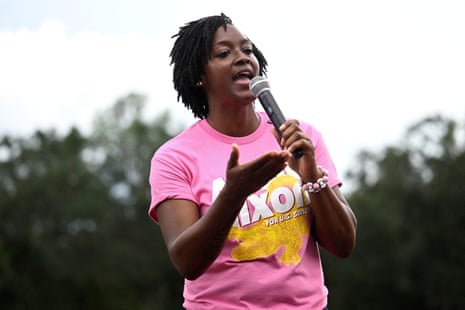
Will Angie Nixon get the campaign money from her opponent who lost?
Nola67 asks Alex Vindman had $16 million fundraised during his losing campaign against Angie Nixon [to be the Democrat’s Senate nominee in Florida]. Will he be giving that money to Nixon now, and is she getting more funding help from the national Democratic Party?
double quotation markJoseph: Our understanding is that he’s using his sizeable war chest to boost Democrats across the country, and to the Florida Democratic state party, though not Nixon herself. He announced back in August that he’d be sending $250k to the Democratic Senatorial Campaign committee and candidates like Abdul El Sayed in Michigan, Troy Jackson in Maine, Roy Cooper in North Carolina, Sherrod Brown in Ohio, Charles Booker in Kentucky, and more.
In Florida, he says he invested $400k to the state democratic party, though not directly to Nixon herself. It seems like the Senate Majority PAC, led by Chuck Schumer and meant to boost Democrats to the Senate, are steering clear of Nixon’s campaign – it seems they don’t find that one winnable, and don’t want to put the investment into it.
Can AI take on the complex process of recouping investor debt?
Golfcart321 asks: Could advanced AI systems take on the complex process of recouping or recovering debt for investors or lenders, thereby making it a feasible brokering objective within a component of the US government?
double quotation markDara: Theoretically AI could be used for recovering debt for investors for the government, but given the mistakes and bias the technology still has it would likely need human oversight for this work. It’s more feasible that AI will be used as a tool to help identify trends and organize material, but then people would have to direct this work and keep tabs on the technology to ensure all rules and regulations are being followed.
Can we trace where political spending ends up?
nycreader2 asks: If someone donated millions of dollars to a political campaign, what would they realistically expect to get out of it? Are there things we can actually trace from political spending to policy decisions, or is that much harder to establish?
double quotation markDara: This is tricky because when we see big donations to political campaigns, we don’t usually hear politicians say they’re making policy decisions to benefit that donor. That said, I think we can infer cause-and-effect in some situations.
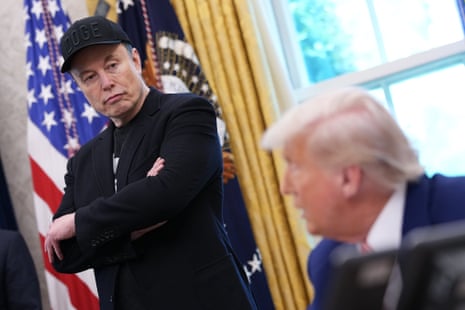
The biggest example that comes to mind is Elon Musk spending at least $250m to get Donald Trump elected in 2024. That was one of the largest individual donor contributions we’ve seen in a US presidential campaign. The day Trump was inaugurated, one of his first actions in office was to create the Department of Government Efficiency and put Musk in charge. In the following months, we saw Musk and his cohort dismantle many government agencies that were charged with regulating his network of companies.
There are other examples of this with Trump and the tech industry. We’ve seen many leaders from the top AI companies donate to Trump and contribute to things like his inauguration committee and the White House ballroom and, in turn, get a light touch when it comes to regulation. Just the past couple of weeks, we’ve seen politicians from across the spectrum call for more regulation of AI and Trump being one of the few vocal naysayers. I recently wrote a longer story about this and Trump’s close ties to the Silicon Valley venture capitalist David Sacks.
How much of a role is crypto playing in the midterms?
WillDean asks: One of the biggest stories in British politics in 2026 has been a couple of large donations to Reform from two crypto billionaires that are large enough to have a dramatic impact on the entire political landscape. How much of a role is crypto money playing in the midterms – and does it make less of an impact there because there is so much money being spent everywhere already?
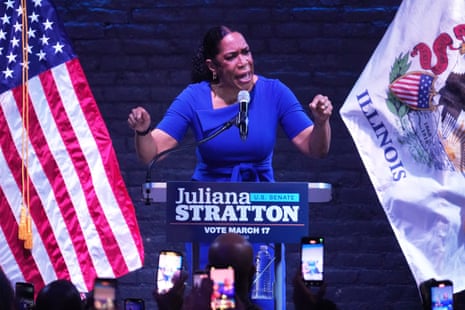
double quotation markChris: Super Pacs tied to cryptocurrency spent millions in the primaries, though they didn’t always achieve the desired result. One of the major players is called Fairshake, which has made more than $13.3m in independent expenditures this year in Illinois, including nearly $2.5m against state lawmaker La Shawn Ford, who nonetheless won the Democratic primary for a US House district, and nearly $9.9m against lieutenant governor Juliana Stratton, who won the Democratic Senate nomination anyway. They also spent about $800,000 against state senator Robert Peters, who lost the primary for another US House district. That’s not the last we’ll hear of Fairshake this cycle — they are reportedly planning to spend $30m against Sherrod Brown, a Democrat and cryptocurrency foe who is running to return to the Senate in Ohio.
Can Republicans’ spending overcome their unpopularity?
Sam_Jenks asks: The Republicans are better placed to take advantage of the supreme court ruling on spending in terms of the final advertising blitz, apparently outspending the Democrats by over $200 million. Is that enough to overcome factors like Trump’s low approval rating? Can a party who are clearly less popular than the opposition just brute force their way to victory if the spending deficit is large enough?
double quotation markChris: That’s the big question of these midterms, and one that can’t be answered definitively before we know the results. But here’s what I can say now: While some Democratic candidates are beating their opponents in fundraising at the candidate level, Republicans overall are expected to outspend Democrats in the cycle, when factoring in outside groups like Super Pacs. That doesn’t necessarily mean they’ll preserve their majorities in the Senate and House of Representatives — Kamala Harris outspent Donald Trump in 2024, and lost anyway. But the headwinds facing Republicans are really formidable, from Trump’s terrible approval ratings, to Democratic candidates’ strong performances in special election and primary turnout, to the price increases for gas and other staples caused by the Iran war. This piece I wrote this week goes deeper into those dynamics.
Will the Save Act have any influence in November?
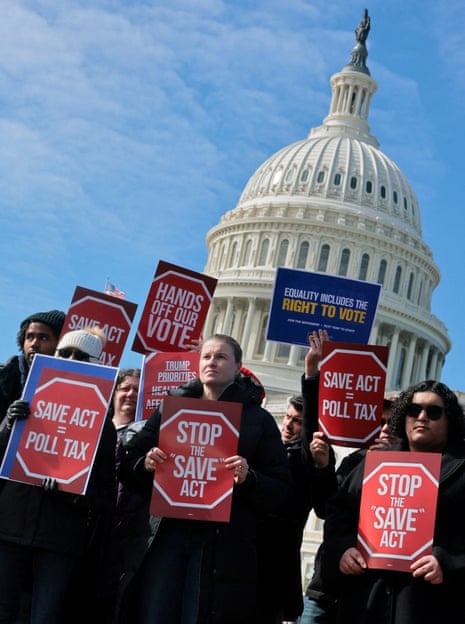
NeilNaik asks: What aspects from the Save America act should we be concerned about, and how much of it is realistically going to be implemented for this November.
double quotation markChris: The legislation you are referring to, which is now known as the Save America Act, has passed the House of Representatives but not the Senate and thus has not been enacted, so none of its provisions will be implemented in time for the 3 November midterms. However, Donald Trump and his administration have attempted to put in place some of the act’s restrictions on voting via executive order. These efforts have not gone too well for him. Trump’s attempt to impose new restrictions on mail-in voting, for instance, was halted by the supreme court.
How likely is it that California’s billionaire tax will pass?
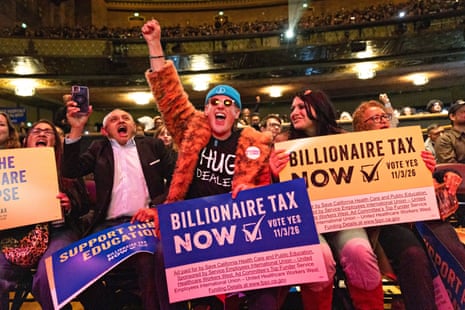
brooklandia897 asks: Could you talk about the California races and how likely it is that the Prop 40 billionaire tax will go through? Obviously billions have been spent by billionaires trying to stop that one! So is there hope for it actually going through in spite of all that?
double quotation markDara: The billionaire tax is looking to be the most expensive ballot measure race in California history, which is saying something since we saw Uber and Lyft spend more than $200m to defeat a ballot measure for workers in 2020. For Prop 40, tech-backed Super Pacs are spending hand-over-fist to defeat the measure. The biggest spending Super Pac is called Building a Better California and has seen donations from several Silicon Valley venture capitalists and tech royalty, including Google co-founder Sergey Brin and former Google CEO Eric Schmidt. (Also, weirdly, Kim DeGeorge, the wife of the wealthy owner of the Alo yoga clothing brand, has been a regular donor). Since the Super Pac launched in February, it’s raised $229m.
Just for background, Prop 40 would put a one-time 5% tax on all billionaires living in the state. The proceeds would go to mostly fund healthcare programs, along with some education and food assistance programs.
Polling for Prop 40 shows that voters are leaning to support the measure, but that support has lost strength over the past few weeks. Still, the measure has the support of California’s Democratic party and the powerful California Federation of Labor Unions.
Complicating matters are Prop 41 and Prop 42, two separate measures that billionaire tax opponents got onto the November ballot. Prop 41 directly targets Prop 40, and Prop 42 is more of a general anti-wealth tax. If either of these measures get more “yes” votes, they will stop Prop 40 from taking effect – even if Prop 40 passes. So California’s billionaire class is spending not only to defeat Prop 40, but to push Prop 41 and 42.
What does money from a Super PAC actually buy?
NorthLondonIsRed asks: When a Super PAC or corporate donor spends heavily on a race, what does that money actually buy in practice? Is it mostly ad volume, field organizing, opposition research, or something else? And how much measurable difference does that spending make in swinging votes compared to factors like incumbency or local turnout?
double quotation markChris Stein: A Super Pac has wide latitude for what it can spend its funds on in support of a candidate or cause. Typically, Super Pacs run advertisements in the media — think television, streaming services and websites — produce campaign signs and bumper stickers, and fund canvassing and phone banking. Does this make a difference? It depends on the race. This year, the Super Pac connected to the American Israel Public Affairs Committee (Aipac), called the United Democracy Project (UDP), spent heavily to support Democratic congressman Wesley Bell in St Louis, Missouri, who was facing a primary challenge from Cori Bush, the former US House lawmaker he unseated with the UDP’s assistance in 2024. Bush was outspent and Bell won his primary by a wide margin, but when I reported on this race from St Louis it became clear the former congresswoman had other issues beside lack of funds. But UDP also spent heavily in Michigan’s Democratic Senate primary to support congresswoman Haley Stevens against Abdul El-Sayed. It didn’t work — El-Sayed won the nomination, albeit by a narrower margin than expected.
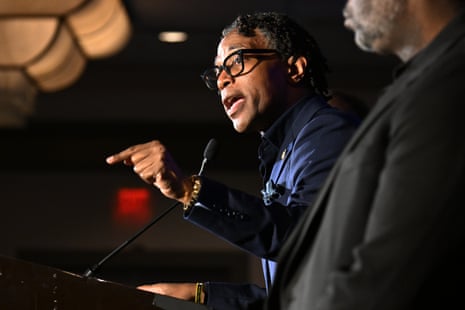
Joseph, Dara Kerr and Chris are live answering your questions now.
Welcome to the conversation
Welcome to our second live Q&A about the upcoming midterm elections. Today, our reporters will be joining us to answer your questions about who is funding the campaigns, where the money is going and how it’s shaping the election outlook ahead of the votes on 3 November.
In the past few months our reporting team has covered in depth:
-
How major companies that urged Congress to strengthen the Voting Rights Act continue to contribute to state political groups that are actively working to undermine the legislation.
-
The vast extent of spending by crypto money and big tech to shape this year’s races.
-
Aipac and its linked Super Pacs’ role in funding Democratic candidates facing opponents from the progressive left.
Joining us on Friday at 11am EDT are political breaking news reporter Joseph Gedeon, tech reporter Dara Kerr and senior politics reporter Chris Stein.
Sign in or sign up to join the conversation.
The US politics team is hosting a series of reader Q&As leading up to the November midterms elections. See our first conversation on the Democrats’ midterms hopes.