Lalita Chemello / Jalopnik
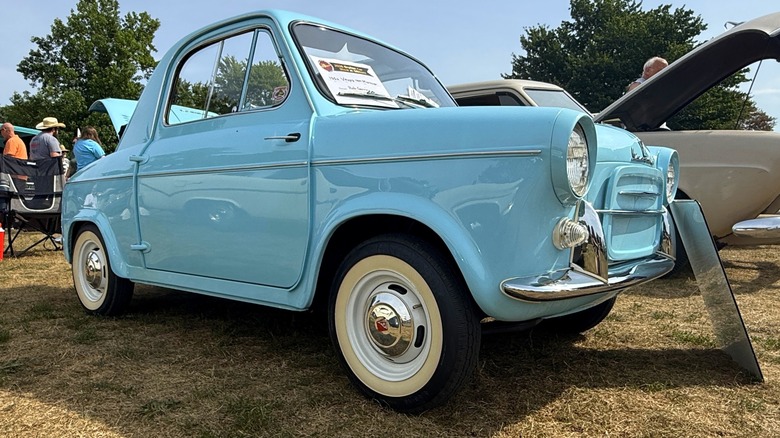
The early years of Piaggio's Vespa were wild. The company spent the first decade of its existence racing, rather successfully. As it conquered the scooter racing world, Piaggio contemplated another venture. Perhaps the timing was done purposely, but as racing ended, Vespa was tasked with a new project — making an adorable, affordable microcar. But this little French-made Italian car's life was short-lived, as Piaggio decided Vespa should focus on making its scooters instead.
Vespa began producing its first scooter model, the 98, in 1946. The following year, the company sent its scooters racing, and you can read more about it in one of my prior articles. Racing was doing what Piaggio would hope it would do for Vespa, which was get its name out there so people would continue buying the scooter. And it worked. Italy, and eventually the world, was more mobile thanks to the Vespa. But what would be next? Vespa attracted youthful riders who would potentially need something more practical, or a next step up after the scooter. So in 1952, Piaggio tapped Corradino D'Ascanio, and designer Cario Carbonero to create Vespa's only car: the 400.
A tiny Italian 'Beep, Beep'
Lalita Chemello / Jalopnik
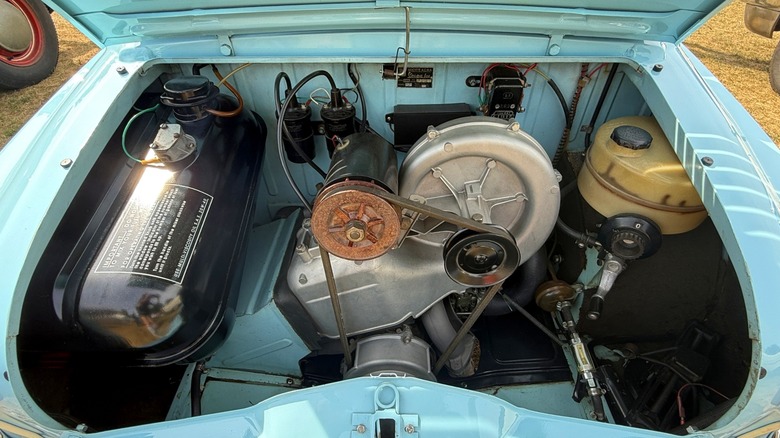
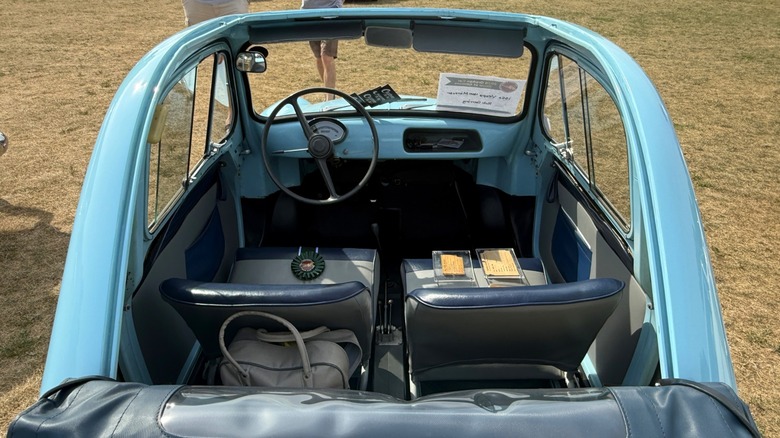
The Vespa 400 was a microcar, consisting of an air-cooled two-stroke twin-cylinder 394 cc engine sending power to the rear wheels. Its maximum speed was about 55 mph, although some articles printed in the U.S. in 1959 and 1960 would advertise that at 60 mph. Available in six colors, it featured a fabric roll-top and a neat hideaway drawer at the front of the car where it housed its 12-volt battery. The two-stroke engine was a little finicky, as it required a special fuel-oil mixture ratio of 50:1 (gas stations provided a 20:1 ratio). So, the first model year had a few more problems than the following model years as Piaggio corrected the problem by incorporating an oil metering system to the engine to help maintain a proper mixture.
The 400 was announced at the Paris Salon in 1956, and made its official debut in 1957, which RM Sotheby's writes took place in Monaco "with three renowned grand prix drivers." As to who those drivers are remains a mystery.
Piaggio used its high-output French factory A.C.M.A. (Ateliers de Construction de Motocycles et d'Automobiles) for the production of the 400. The first 400s made it to market just four months prior to the Fiat 500's debut.
About 30,000 Vespa 400s were made — contrary to a July 1959 Boston Globe article where a new American distribution company claimed over 50,000 400s had been sold in France. The 400 did fairly well in the U.S. as it was about a third of the price of a Volkswagen Beetle. An article from the San Antonio Light in September of 1959 focused on the Armed Services Buying Co-op anxiously awaiting the arrival of Vespa 400s to sell. The price then with tax and licensing fees came out to around $1,135, which is about $13,000 in 2026. The U.S. sold 514 400s in 1959 and 1,138 in 1960. 1961, the sales numbers fell off a bit, which coincided with Piaggio's decision to end production.
A microcar struggling in a mini car world
Lalita Chemello / Jalopnik
When the 400 was launched, the Fiat 500 came to market just months later. The Mini, as well as Citroën's 2CV were also in the "mini car" category and already well-established in European markets. Although the 400's numbers don't appear to be terrible, with only 30,000 units made in total, it wasn't enough to compete against the other European small cars.
It was Piaggio's decision to end production in 1961. According to d'Ascanio's personal notes from the company's historical archive, he said, "considering that potential two-wheeled competitors would serve as effective advertising for the Vespa, while for four-wheeled vehicles would face competition around the world, he [Piaggio] deemed it appropriate to cease car production and intensify production of Vespas and their derivatives." One could argue the 400 was, indeed a derivative of the Vespa. But in a post-war world already well-infused with Minis, 2CVs, and Fiat 500s, the 400 would just continue to struggle.
 Lalita Chemello / Jalopnik
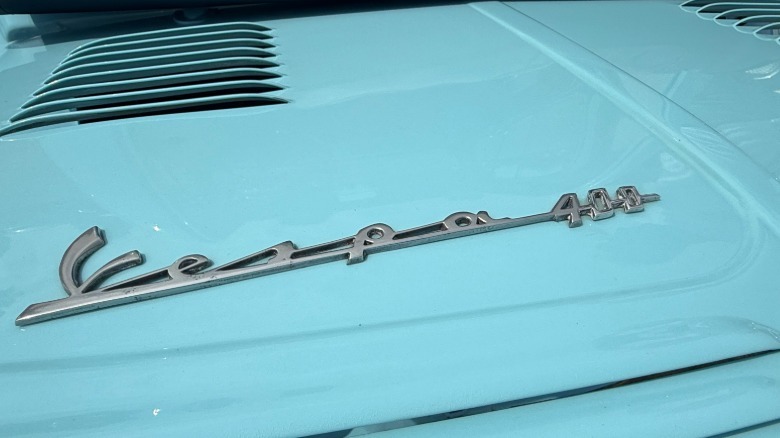
Piaggio never made another car. It did make some car-like three-wheeled vehicles known as Apes, but those were basically just covered three-wheeled scooters, and that one fire engine.
Much like Piaggio's push for and ending of Vespa racing, those intrigued by this story are left contemplating what could have been if the 400 went through another iteration. But then again, Vespas were designed to get an impoverished post-World War II Italy mobile again. Anything Piaggio's team would have designed or improved-upon car-wise might have continued to have existed at a loss when still competing with other European mini cars. Perhaps it was truly better off just having its brief, delight short existence. Plus, its scooters remained wildly successful.