Livestock farming requires valuable land to grow fodder, uses vast amounts of freshwater and contributes to global warming through methane and nitrous oxide emissions. And, for many consumers it is important to prevent animal suffering. For these reasons, the global market for meat alternatives is currently worth €6.7 billion to €8.1 billion per year and is projected to grow 8.1% to 12.3% each year over the next decade.
One common method for producing fake meat is microbial engineering, in which genes coding for animal proteins are inserted into the genomes of bacteria or yeast for mass production in bioreactors. But now, scientists have developed a promising alternative as a proof of principle.
"Here we show that plants can be engineered to produce the animal protein myoglobin (Mb) in their chloroplasts, the energy factories for photosynthesis. This could provide a more sustainable way to produce an important ingredient for plant-based meat products," said Dr. Alexia Groff, a researcher at Imperial College London.
The results are published in Frontiers in Plant Science.
Beefing up plants
Myoglobin is an important component of the heart and skeletal muscle of vertebrates. Myoglobin is rich in iron, which is why meat has a metallic and umami flavor, while the oxygen bound to it gives meat its red color. Groff and colleagues first cloned the genes for pig and cattle myoglobin.
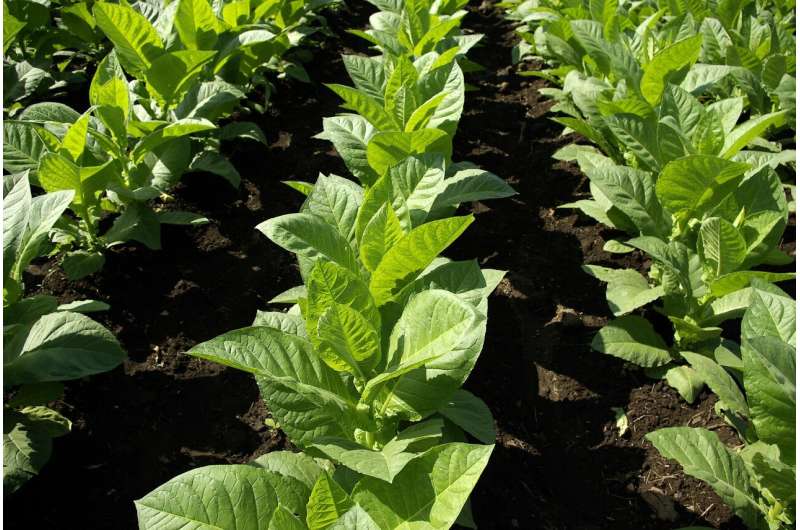
They then used a so-called "gene gun" to physically shoot copies of the genes into the chloroplasts of tobacco and lettuce seedlings in the laboratory. Tests confirmed that some seedlings had subsequently integrated the gene into the short, ringlike genome of their chloroplasts. The plants were then grown to adulthood, flowered and set seed, with their offspring inheriting the transgene.
For comparison, the authors also inserted the gene into the much larger nuclear genome of both plant species, as well as into the chloroplast of the unicellular alga Chlamydomonas reinhardtii.
"Due to their bacterial ancestry and their high number of copies per cell, chloroplasts are generally much better at making large amounts of protein than the cell nucleus," said Groff. "Here, we used tobacco because it is the best model plant for developing this technology, and lettuce because it is an edible crop that could eventually be used for food ingredient production."
Measurements by liquid chromatography–mass spectrometry showed that myoglobin yields were approximately 800 mg per kilogram dry weight of tobacco and 810 mg per kilogram dry weight of lettuce. This was at least three times higher than the yield from tobacco plants with the transgene spliced into the nuclear genome. Real meat contains between 8.1 and 11.2 mg myoglobin per gram dry weight.
"Despite this, plant cultivation is far more resource-efficient than livestock production; consequently, plant-derived Mb could achieve protein yields per hectare that rival—or even potentially exceed—those of animal agriculture, while also benefiting from substantially lower water use and greenhouse gas emissions," the authors wrote.
Planting a seed for future production
What are the next steps before the discovery can be commercialized? "The myoglobin could be extracted from leaves and purified using industrial protein purification methods. Since it is identical to animal myoglobin, it could then be added as an ingredient to plant-based meat products to improve their color, flavor and nutritional value," explained Groff.
"We hope that edible lettuce, modified to express myoglobin, could also one day serve as a heme-iron-enriched biofortified food, depending on legislative approval," added co-author Dr. Kyoko Morimoto, chief scientific officer at Kyomei, a Cambridge-based plant biotechnology startup.
Publication details
Sustainable production of myoglobin meat protein in plant chloroplasts, Frontiers in Plant Science (2026). DOI: 10.3389/fpls.2026.1876707
Who's behind this story?

BSc Life Sciences & Ecology. Microbiology lab background with pharmaceutical news experience in oil, gas, and renewable industries. Full profile →

Bachelor's in mathematical biology, Master's in creative writing. Well-traveled with unique perspectives on science and language. Full profile →
Citation: Powerhouses for fake meat: Muscle protein can now be grown in chloroplasts of lettuce and tobacco plants (2026, August 6) retrieved 6 August 2026 from https://phys.org/news/2026-08-powerhouses-fake-meat-muscle-protein.html
This document is subject to copyright. Apart from any fair dealing for the purpose of private study or research, no part may be reproduced without the written permission. The content is provided for information purposes only.