Give EverBoard’s new 21.5-inch tablet just three words — say, “sushi juggling cats” — and it can generate an original playable game.
EverVibe Game Creator leverages generative AI to create these play experiences that blur the line between board games and mobile games. In this test case, that means a game starring a juggling cat, its rival, a scoreboard, and artful pieces of salmon nigiri, maki, and tamago sushi that players must keep in the air. The onboard AI might even suggest ways to improve the game: different point values for each type of sushi, combo streaks, or turn-based rounds supporting up to four players.
“Sushi Juggling Cats” may sound like the sort of game thing that a child might blurt out on a chaotic car ride when they’re overtired, but that’s also the point. EverBoard was announced Thursday morning as a new $499.99 digital game table launching exclusively through Best Buy this holiday season. The company is betting that families want more than just digital versions of Monopoly and Scrabble — it wants to use AI to let imaginations run wild.
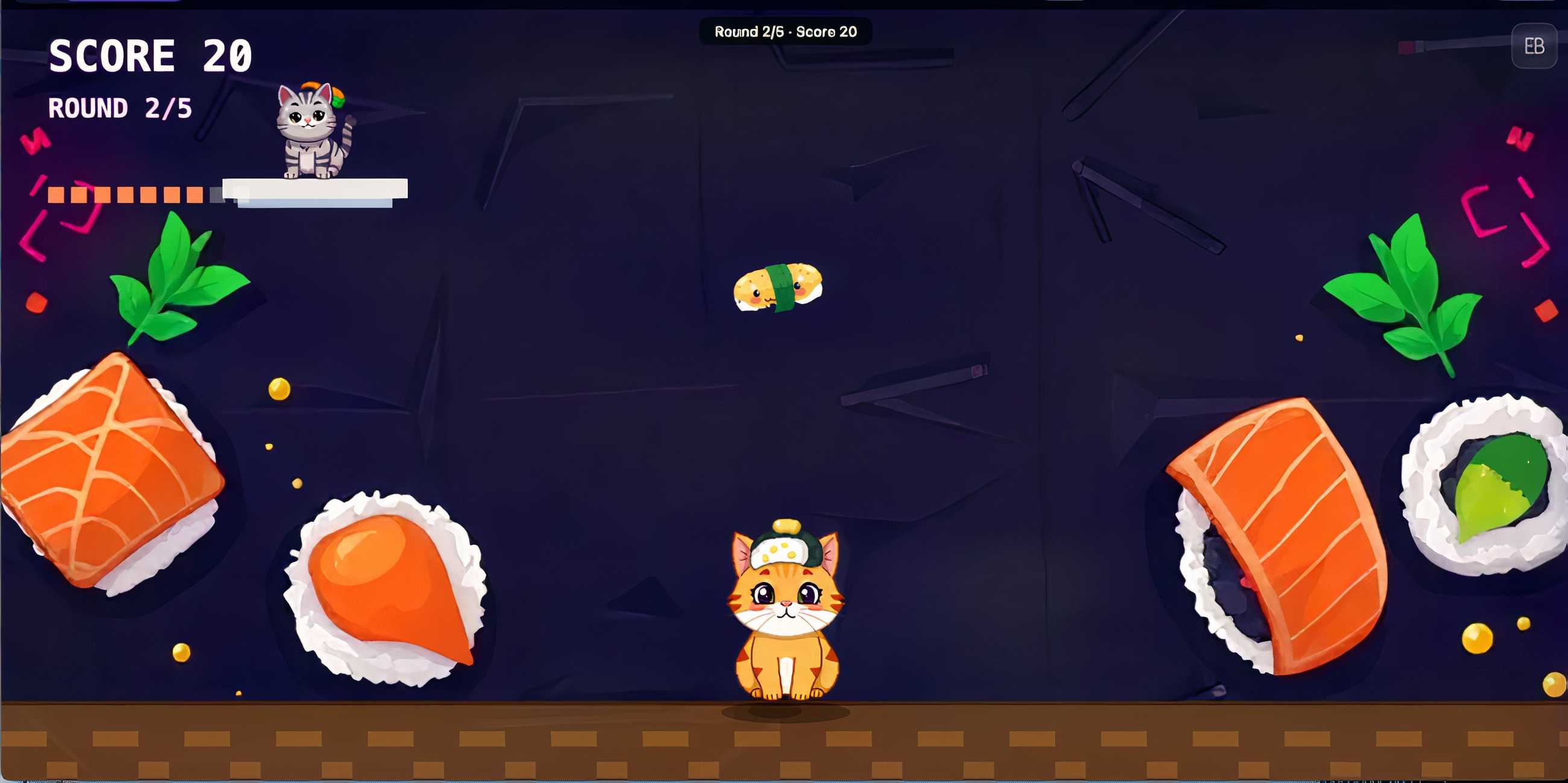 Image: EverBoard Inc.
In responses provided exclusively to Polygon, the company revealed new details about how EverVibe uses generative AI to create games, what safeguards it uses to protect younger players, and how much continued access to its defining feature will cost.
EverBoard itself is essentially a 21.5-inch, 1080p touchscreen designed to be placed at the center of a table. Its 10-point touchscreen supports up to six people playing from all four sides, with controls oriented toward each player’s seat. A fold-out stand also allows the screen to lie flat, stand upright in portrait mode, or sit in a traditional widescreen orientation.
The device has a built-in battery and comes with a carrying case. While it’s somewhat large, it’s also designed for full portability. The EverVibe Game Creator, however, is what separates it from the growing number of devices attempting to take over family game night.
How EverBoard’s AI game creator works
Players can speak or type a description of the game they want to play (and use far more than just three words), or choose from menus containing possible themes, rules, controls, and visual styles. EverVibe then asks a handful of setup questions, including how many people are playing, where they’re seated, whether the game should include computer-controlled opponents, and whether it should use tapping, dragging, or directional-pad controls.
For casual players, that process can produce a quick variation on a familiar type of game. More ambitious creators can establish custom rules, turn structures, scoring systems, objectives, and win conditions. EverBoard says players can customize everything, from the board and characters to the artwork, sound, and music.
 Image: EverBoard Inc.
Once EverVibe produces a game, players can refine it with plain-language instructions like “make it faster,” “add power-ups,” or “change the board to outer space.” Each revision is saved as a new version, so if the AI takes the game in the wrong direction, it can always return it to a previous iteration.
One example provided to Polygon, Bluff & Bluster, began with the prompt, “a bluffing card game where you lie about the cards in your secret hand.” EverVibe created a game for two to four players seated on opposite sides of the screen, complete with hidden hands and customizable card backs.
To make that possible on a shared display, EverBoard includes four privacy films that players can slide over designated sections of the screen. Cards and tiles inside these zones remain visible to the player sitting directly in front of them but are obscured from anyone sitting across the table. In Bluff & Bluster, opponents see the cards facedown until a player drags one out of their private zone.
Families will eventually be able to publish their creations to an EverBoard community library. Games remain private unless an adult approves them for publication, after which EverBoard’s moderation team will review them before allowing other families to play.
AI creation comes with limits — and another subscription
EverVibe uses generative AI models supplied by what EverBoard describes as “established commercial providers.” Prompts are routed through EverBoard’s cloud service, so customers never deal with any sort of third-party account.
An adult has to configure the device and can decide whether EverVibe is enabled, along with who is allowed to use it. EverBoard says that any questions that break the company’s content rules are “declined politely.” The company plans to publish its full privacy notice and adult-managed consent process before the product ships.
Private games remain in the device’s library, although requests must be sent to EverBoard’s AI providers to generate or revise them. The company says it will not train AI models using players’ prompts or creations and that its contracts will prohibit its providers from doing so as well. Only games that an adult elects to publish will be stored for other users to access.
Using EverVibe will require more than the initial $499.99 hardware purchase. Every EverBoard includes one month of EverPass, the platform’s subscription service, which provides access to its full library and the capacity for five Game Creator creations per month. EverPass costs $29 for three months or $99 annually.
EverPass Premium costs an additional $50 per year and offers five times the “creation power”: up to 25 quick games per month, five enhanced games, or a combination of the two. EverBoard says those allowances remain subject to change as it continues testing and developing EverVibe.
 Image: EverBoard Inc.
Without an active subscription, owners can still access a free starter collection of 10 games. Resubscribing restores the full catalog, which EverBoard says will include more than 50 games at launch and additional releases released monthly.
Confirmed Hasbro games so far include Monopoly, Connect 4, Chutes and Ladders, and Scrabble, along with puzzles, drawing activities, arcade-style games, and other original experiences. Hasbro also owns Clue, Risk, Battleship, Candy Land, The Game of Life, and plenty of other classic board games, but it’s unclear which will be included.
Digital game tables have been here before
EverBoard is far from the first company to pitch a large touchscreen as the future of family game night. When I reviewed Arcade1Up’s Infinity Game Table in 2021, I compared it to the Amazon Kindle: one device capable of storing a growing library of familiar board games. It supports six players and used to include digital Hasbro games — until that license expired. Half a decade later, as AI has become increasingly more prevalent, EverBoard looks and probably feels rather familiar to the Infinity Game Table with the obvious upgrades.
More recently, Board pursued the same intersection of physical and digital play from another direction, utilizing bespoke physical components to play games intended specifically for its 24-inch display.

Aside from the privacy films, EverBoard doesn’t seem to have much in terms of accessories at this point. And it seems to marry everything that the Infinity Game Table and Board have to offer: licensed Hasbro board games on a digital touchscreen alongside other bespoke gaming experiences. The key difference here is that you get to create your own games as well. It’s also smaller and more portable, because it runs on a battery and doesn’t require continuous AC power. Even without EverVibe, it would feel like the natural next step forward for this kind of console.
EverVibe arrives amid widespread skepticism about generative AI’s role in creative industries, including game development. Critics often question whether certain AI models were trained on artists’ and designers’ work without their permission, while developers have raised concerns that companies could use the technology to replace creative labor or even flood marketplaces with low-quality material. Those questions are particularly relevant for a tool that promises to generate rules, artwork, characters, sound, and music — work that is ordinarily performed by game designers, artists, writers, and composers. EverBoard has not identified which commercial AI providers power EverVibe.
Whether EverBoard becomes the definitive digital game table may depend on if EverVibe can produce games that families genuinely want to play more than once. “Sushi juggling cats” sounds pretty funny, and the image of gameplay seems like enough to delight any child. But turning three words into a good game is a much harder thing to pull off — especially when I try to think about all the weird prompts my own four-year-old might try to give it.