The UK’s fifth heatwave of the summer has “presented exceptional challenges to the railway”, Network Rail has said, after two trains derailed in less than 24 hours.
On Friday, British Transport Police (BTP) confirmed the rear carriages of a Greater Anglia train derailed “in an upright position” at Wickford railway station in Essex, adding that there were no reported injuries. On Thursday, two people were seriously injured when several Southern train carriages left the track near Lewes in East Sussex and ended up on their side, trapping passengers onboard.
Martin Frobisher, the group safety and engineering director at Network Rail, said it was “working quickly to understand the situation and to provide assistance where needed”.
He urged people to avoid speculating on the causes of the Wickford and Lewes derailments and said that Network Rail would conduct internal investigations to look at causes and factors.
The derailed train in Essex was travelling from Southend to Liverpool Street with about 40 people onboard. It left Rayleigh at 2.06pm but failed to reach Wickford at 2.11pm as planned.
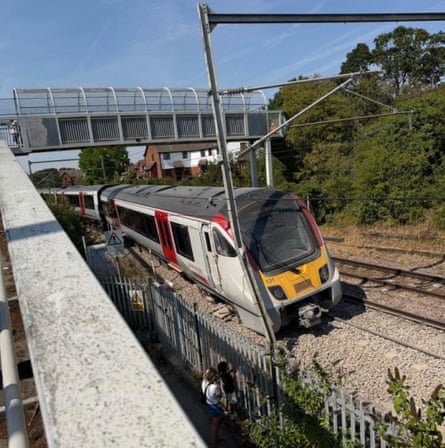
A post on the National Rail website said all lines were closed between Wickford and Southend Victoria. This meant trains running between London Liverpool Street and Southend Victoria were unable to operate.
The Rail Accident Investigation Branch (RAIB) said on X that it had deployed inspectors to the site to gather evidence.
BTP declared a major incident on Thursday afternoon after the derailment near Lewes. About 150 people had been on the service from London Victoria to Eastbourne, which was evacuated. Two people were taken to major trauma centres with severe injuries. BTP said on Friday the injuries were not deemed to be life-threatening.
Southern urged customers planning to travel this weekend to check ahead as significant disruption was expected across parts of the network until further notice. Trains are expected to be extremely busy, with customers advised to allow at least one extra hour for their journey.
Frobisher said: “The unprecedented hot and dry weather that we have experienced this summer has presented exceptional challenges to the railway. In response, we have taken several additional proactive steps to manage and mitigate the impact on the railway, including closely monitoring the temperature of tracks, implementing speed restrictions where it is appropriate to do so, and planning track renewals around high temperatures.”
He added: “We will also conduct our own internal investigations, in which we will look at all possible causes and factors. I appreciate the public will be concerned at the news of two derailments of passenger trains over a short period of time, but I want to reassure them that Britain’s railways still rank among the safest in the world and that safety is always our first consideration on the railway.”
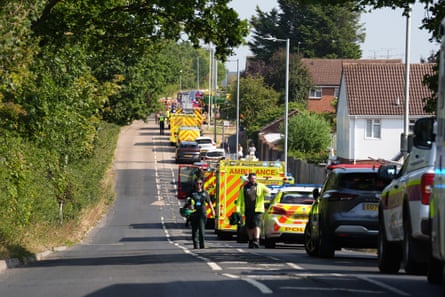
John Whitehurst, the chief executive of Greater Thameslink Railway (GTR), which operates Southern, praised four railway workers onboard the Lewes train – the driver, onboard supervisor, a spare driver and an off-duty member of staff – who initial reports suggested had “acted quickly to help make the railway safe and support passengers during the evacuation”.
“Their actions are a powerful example of colleagues putting passengers first in very difficult circumstances,” he said.
After the incident, Whitehurst insisted the railway was safe in hot weather. He told BBC Radio 4’s Today programme that derailments were “incredibly rare”, adding that what happened “was a very serious incident and I’m deeply saddened by it”. He said “a full investigation” was under way with the RAIB.
after newsletter promotion
Richard Bowker, a former chair of the Strategic Rail Authority, told the same programme that the inquiry would look at the effects of heat on the damaged track, including whether the ground below the track had dried out.
James MacCleary, the Liberal Democrat MP for Lewes, told Times Radio that concerns had been raised about tracks being “a bit bumpier in recent months” in the area as a result of the sustained heatwaves.
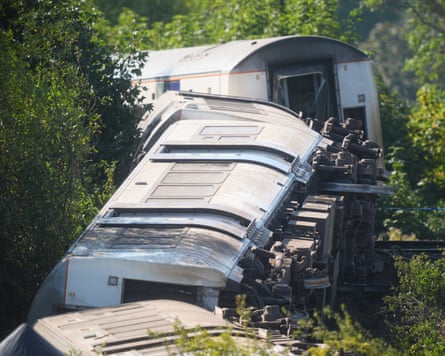
Gareth Dennis, a railway engineer and author of How the Railways Will Fix the Future, said although there was no firm evidence to connect the two derailments, “the likelihood of two similar derailments in the hottest part of the country happening in quick succession without a common cause is extremely low”.
He added that there was a high likelihood that the derailments were caused by a track buckle, where steel rails that have expanded in the heat snap into a buckled shape under the wheels of a passing train, though there are other possible causes.
Xueyu Geng, a professor in ground engineering at the University of Warwick, said steel rail was known to expand significantly in extreme heat, with a 1C rise in temperature causing approximately 11mm of expansion per kilometre of track.
A Department for Transport spokesperson said: “We are aware of a derailment involving a Greater Anglia train near Wickford, Essex. The train is upright, there are no reported injuries and investigators have already been deployed to the site.
“Our railways remain amongst the safest in the world and while incidents like this are extremely rare, when they do occur, they are taken very seriously.”