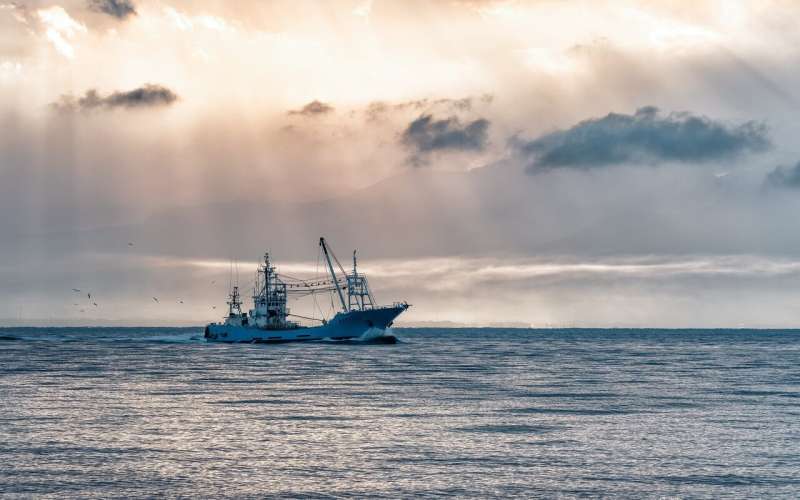
Industrial-scale illegal fishing continues to undermine ocean sustainability, coastal livelihoods and global seafood markets—despite decades of regulation and recent advances in surveillance technology, according to new University of British Columbia (UBC) research.
"Illegal fishing is not a fringe activity, but a systemic feature of the global seafood economy, enabled by weak governance, harmful subsidies, opaque corporate structures and complex international supply chains," said lead author Dr. Philippe Le Billon, professor at UBC's Department of Geography and School of Public Policy and Global Affairs.
The study, "Casting light on the workings of illegal fishing markets," was published in Proceedings of the National Academy of Sciences.
The comprehensive analysis examines how illegal fishing operates, where it is concentrated and why it persists. "Illegal fishing remains profitable because the risks are low and the rewards are high," said Le Billon. "Even as detection improves, enforcement and accountability lag behind—particularly for large industrial fleets operating far from public scrutiny."
A global problem with unequal impacts
The study reported that industrial-scale illegal and unreported fishing accounts for approximately 8% to 15% of global marine wild capture, underpinning an illicit seafood trade worth US$6.2 billion to US$12.2 billion annually.
While illegal fishing occurs worldwide, its impacts are highly uneven. Roughly two-thirds of the illicit trade by value originates in West Africa, East Asia and Southeast Asia—regions where enforcement capacity is often limited and fisheries are central to food security and employment.
At the same time, much of the illegally caught seafood is consumed in wealthier markets in North America, Europe and East Asia, highlighting stark global inequities.
"The environmental and social costs are borne largely by developing coastal states, while the economic benefits flow elsewhere," said Dr. Rashid Sumaila, co-author and professor at UBC's Institute for the Oceans and Fisheries and the School of Public Policy and Global Affairs.
Eliminating harmful subsidies key to comprehensive reform
"Effective action against illegal fishing requires coordinated, multilevel responses," said Sumaila. "Reducing illegal fishing is not just about catching more offenders, it is about fixing the systems that make illegality profitable and legal fishing harder—especially for those who depend on the ocean the most."
Key priorities include eliminating harmful fisheries subsidies, mandating electronic vessel identification, strengthening port state controls, increasing transparency around beneficial ownership and improving international cooperation. Equally important are policies that protect small-scale and Indigenous fisheries, promote co-management and align economic incentives with sustainable and legal practices.
As daunting as the challenge of curbing illegal fishing appears, there are some positive signs, the current geopolitical shocks to the global governance system notwithstanding. For example, the WTO ratified an agreement known as Fish 1 to remove certain harmful subsidies in 2025, while working to strengthen this in a follow-up agreement known as Fish 2, currently opposed by India, Indonesia and the U.S.
Also, the High Seas Treaty entered into force on Jan. 17, 2026. Further evidence that the world can collaborate to stop illegal fishing is that "China has finally become a party to the Agreement on Port State Measures (PSMA). To turn these hopeful signs into real action on the water, individuals and civil society have to relentlessly push governments and businesses to tackle illegal fishing," Sumaila added.
How illegal fish enters legal markets
Illegal fishing is sustained by sophisticated laundering mechanisms. At-sea transshipment, fraudulent documentation, species mislabeling and mixing of illegal and legal catch allow illicit seafood to pass through ports, processors and retailers undetected. Weak port controls, inconsistent implementation of international agreements and limited transparency around vessel ownership further enable these practices.
Large distant-water fishing fleets—often supported by fuel and other capacity-enhancing subsidies—are identified as major contributors to illegal fishing. These fleets frequently operate under "flags of convenience," re-register vessels to evade sanctions and use complex corporate networks to obscure beneficial ownership and avoid penalties.
Technology helps—but is not enough
Satellite tracking, artificial intelligence and electronic monitoring systems have dramatically improved the detection of suspicious fishing activity. However, the authors caution that technology alone cannot solve the problem. Enforcement remains fragmented, penalties are often too weak to deter violations and political will is uneven—especially when powerful corporate or geopolitical interests are involved.
Beyond environmental damage
Illegal fishing's harms extend far beyond depleted fish stocks. There are "significant economic losses to governments and coastal communities, increased food and nutritional insecurity, and widespread labor abuses aboard fishing vessels," noted Le Billon.
"Tens of thousands of crew members are estimated to face a high risk of forced labor or unsafe working conditions globally, particularly on vessels operating far from oversight."
Illegal fishing is also linked, in certain contexts, to corruption, smuggling and maritime insecurity, compounding its social and political impacts.
The complex and often opaque character of seafood supply chains allows illegally caught fish to be laundered into global markets through fraudulent documentation, transshipment and weak monitoring at ports, Le Billon concluded.
Publication details
Casting light on the workings of illegal fishing markets, Proceedings of the National Academy of Sciences (2026). DOI: 10.1073/pnas.2512081123
Who's behind this story?

BSc Life Sciences & Ecology. Microbiology lab background with pharmaceutical news experience in oil, gas, and renewable industries. Full profile →

Bachelor's in mathematical biology, Master's in creative writing. Well-traveled with unique perspectives on science and language. Full profile →
Citation: Illegal fishing captures up to 15% of global marine wild catch, analysis finds (2026, August 10) retrieved 10 August 2026 from https://phys.org/news/2026-08-illegal-fishing-captures-global-marine.html
This document is subject to copyright. Apart from any fair dealing for the purpose of private study or research, no part may be reproduced without the written permission. The content is provided for information purposes only.