Alessio Coser/Getty Images
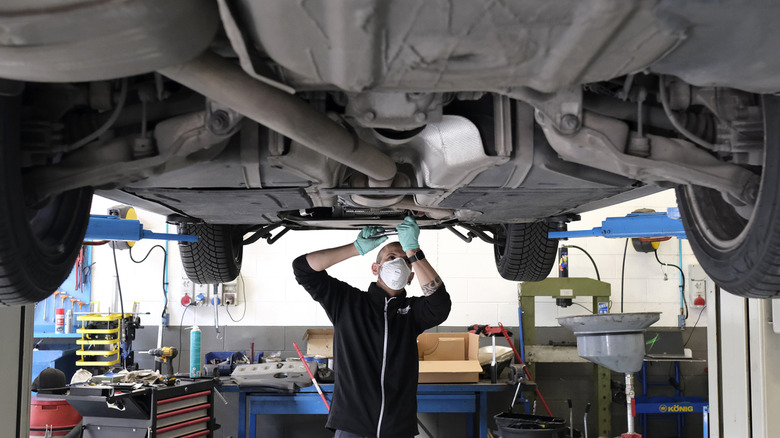
Whether you're a lifelong gearhead who's dreamt for years of opening their own auto body shop or just an enterprising person willing to get their hands dirty for well-paying, in-demand, and satisfying work, now is a great time to break into the auto repair industry. However, knowing what you want to do and knowing how to get there are completely different things, and transitioning from thinking to doing takes some research. We're here to help make that process smoother and make starting out the easiest part of your journey toward being an auto mechanic.
For starters, any aspiring auto mechanic needs to get their high school diploma or their GED. This is the baseline educational requirement for most jobs, and it's no different for auto mechanics. You can be a genius with a wrench, but without a high school diploma or equivalent, you might have a hard time landing a job. Math, reading, communication, reasoning, and even attendance are all areas where your bosses at the shop will want to verify that you have some level of skill. If you don't have a high school diploma, you can still prove these skills by taking the General Education Development test.
Once you've achieved that, you can seek further education, whether that's an associate degree, a bachelor's degree, an Automotive Service Excellence (ASE) certification, a brand certification, or other specialty certs. The more you can prove you know, the better. And these days, it also helps to know as much about wrenching on cars with combustion engines as it does to know about electric car maintenance. The EV market is growing quickly, after all.
Higher education for auto mechanics

Gorodenkoff/Getty Images
Being an auto mechanic isn't just about knowing how to fix dents and rotate tires. It involves myriad skills, from problem-solving and familiarity with different equipment and auto brands to communication with customers and good safety practices. Some of that you'll learn over time, and you'll certainly hone your skills on the job, but entering into a role as an auto mechanic can be made easier by coming in with the right formal knowledge.
While you may have some hands-on experience from taking auto and shop classes in high school, trade schools and community colleges are excellent ways to gain further knowledge in a formal and structured environment. Typically, completing an associate degree takes two years, though some programs are shorter. Depending on where you go, not all of your classes will involve wrenching. You'll need to hone other important skills, from English and communication to electronics and math, all of which will ultimately help you be a better mechanic. On the other hand, this is also a great opportunity to take courses that help you specialize in subfields of the auto repair industry, such as brake repair, engine work, alternative fuels, and more.
Most auto mechanic jobs won't require you to get a bachelor's degree, but pursuing one doesn't hurt, so long as you're in a position to do so comfortably. You'll also want to consider applying for an apprenticeship and becoming ASE certified. An apprenticeship gets you further hands-on experience and helps you start developing relationships in your field, while ASE certification is the industry-standard way of proving your expertise. Some shops may require ASE certification as a prerequisite for employment, as it helps them prove to clientele that the shop takes their work seriously.
Being an auto mechanic means constantly learning
Tigercat_lpg/Getty Images
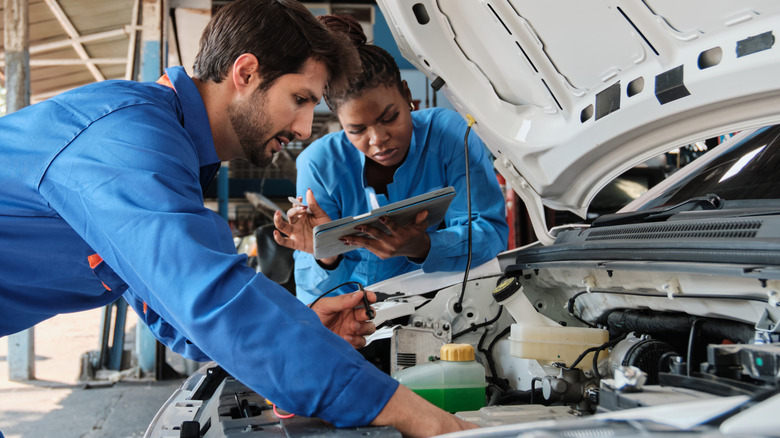
Depending on the type of shop you end up working in, being an auto mechanic may mean working on a wide variety of vehicles, no two of which will ever be exactly alike, or it could mean specializing in one specific area of repairs. Either way, though, the job is one where you never stop learning new procedures, seeing new things, and improving your craft.
There are tons of specialty certifications out there — from EV specialties to collision repair — that you can earn to develop your career. For example, if you want to work on ACs in a car, you'll want to get EPA certified, while you may want to get manufacturer certifications for the brands you see the most, which can help you provide more thorough, knowledgeable service to your customers.
And don't forget, each of these certifications you get and maintain is something that could make you eligible for better pay or a role better suited to your interests and skills. Plus, technology in the automotive world can evolve rapidly, and if you don't adapt, you'll get left behind. If a customer comes in and wants to know how much to expect their EV battery to degrade during its lifetime, and you're only familiar with the lifetimes of gas cars, you could lose yourself a customer. So it's important to remember: you're never done learning, and that's part of the fun.