While dogs are known to turn the puppy eyes on their owners, it seems our pets are keeping a close eye on us too: research has revealed dog brains can distinguish different types of unhappy human faces.
Dr Laura Cuaya, a co-author of the study from the University of Vienna, said previous behavioural studies had shown dogs could tell apart some human facial expressions, but such studies tended to only test two at a time, one positive and one negative. As a result, it was not clear if dogs could distinguish different types of happy or unhappy faces.
Now Cuaya and colleagues have revealed dog brains can not only distinguish happy faces from other expressions, but can tell apart different negative expressions, distinguishing fearful faces from those that are angry or sad.
“This is the first demonstration that the dog brain can distinguish between emotions from the same valence,” she said.
While the team’s previous research has suggested dogs do not have a particular region of the brain devoted to processing faces, Cuaya noted that did not mean the brain activity pattern was the same for the front and back of the head.
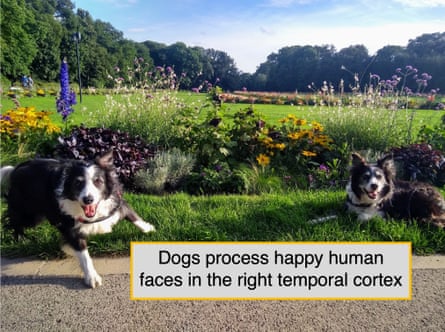
Writing in the journal iScience, Cuaya and colleagues report how they worked with pet dogs that had been trained to voluntarily lie still, awake and unrestrained, within an MRI scanner.
In the first experiment, eight dogs were shown five sets of happy faces and five sets of neutral faces. Each set contained four photos of humans that were unfamiliar to the dog but were of the same gender as their primary caregiver. This was repeated five times for each dog.
The results revealed increased activity in certain parts of the brain when the dogs were shown happy faces compared with neutral ones.
Cuaya said these areas were associated with higher visual processing, social processing and reward processing – suggesting the dog was processing something positive.
Dr Raúl Hernández Pérez, the first author of the study, said the results raised another question, however: “We don’t know if these regions are related just to happy faces or to emotional faces in general.”
The team then carried out a second MRI experiment involving 12 dogs. Each was shown new sets of unfamiliar male and female human faces, this time bearing four different expressions: happiness, sadness, fear and anger.
The researchers used machine learning to analyse activity in the same brain regions identified in the first experiment, revealing such activity could distinguish happy faces from each negative expression – but could not distinguish between different types of unhappy face.
However, when the team analysed activity in the whole dog brain, they found it was possible to distinguish between sad v fearful faces, and angry v fearful faces – with differences in activity in different parts of the brain – but not angry and sad faces.
after newsletter promotion
Hernández said different negative expressions might trigger different responses as they represented a different type of threat.
The authors said it might be harder for dogs to tell apart two human facial expressions if they were both negative or both positive, and dogs might also need additional information – such as body language – to distinguish anger from sadness.
The research has limitations, including small sample size; most of the dogs being border collies, and all were healthy and without behavioural problems.

Cuaya said the study could have practical implications: for example, expressing happiness when training a dog could aid the learning process.
Bridget Waller, a professor of evolution and social behaviour at Nottingham Trent University, who was not involved in the study, described the work as fascinating, saying it showed how dogs have been shaped through domestication to understand human behaviour.
“Smiling is the most commonly used human facial expression, vital to our social interactions, and so it makes sense that dogs have developed a particular ability to distinguish this from other facial movements,” she said. “It seems less clear that they can distinguish between the other facial expressions, and again this would make sense as these are much less commonly produced in human social interaction.”