Artistic Operations/Getty Images
Consumer Reports recently reported that the price difference between buying an EV and buying a car that runs on gas is shrinking, citing Cox Automotive's latest data, which shows that the average price for a new electric vehicle was $54,813 in August. That's down 1.2% versus August 2025, and 2.7% year over year. However, according to the site, the premium — the extra dough you pay to go electric versus gas — is now 9.4%, down from more than 16% last August. This is in addition to EVs saving owners thousands in fuel costs every year.
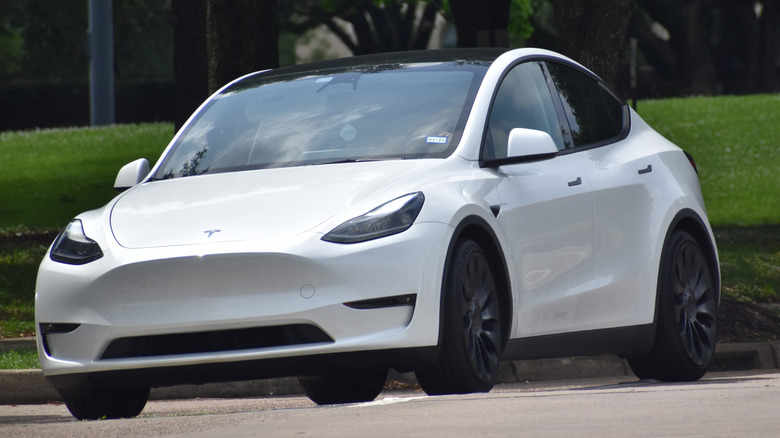
Tesla's market share is slowly recovering in the U.S., with 52% of the EV sales volume, and slightly more than one in three EV sales in America is of a Tesla Model Y. And, according to Cox, if Tesla made your car, the difference between the average new car price of $50,089 and the price of a new Tesla ($52,616), is now just $2,527. However, Cox also notes that more expensive EVs have actually yanked up that average EV sticker, and there are several far cheaper EV options. For example, a Hyundai Ioniq 5 sells for $36,650 (with destination).
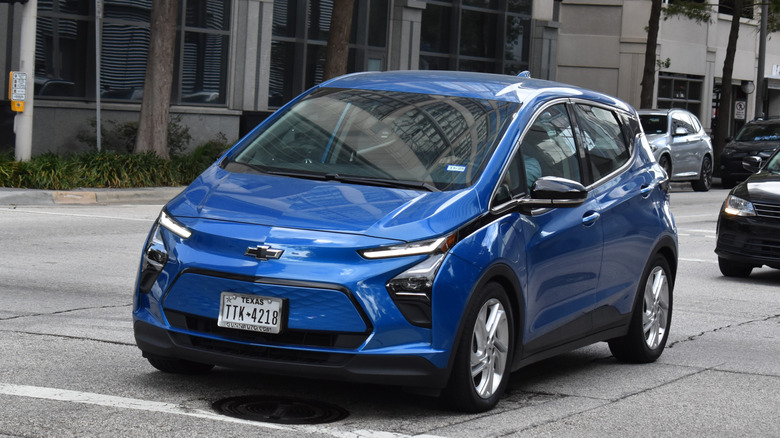
According to the site, the premium for a used EV has also shrunk — to $2,967. In many cases, a used EV is cheaper than an equivalent gas-powered car. For example, the average used 2023 Chevy Bolt will run you $20,632 according to CarGurus, while a 2023 Honda Civic tallies an average of $24,295. Still, what really matters is how much that EV sale price premium can be further offset by cheaper fueling, so let's dive more into that.
The big variable is the price of energy
marekuliasz/Shutterstock
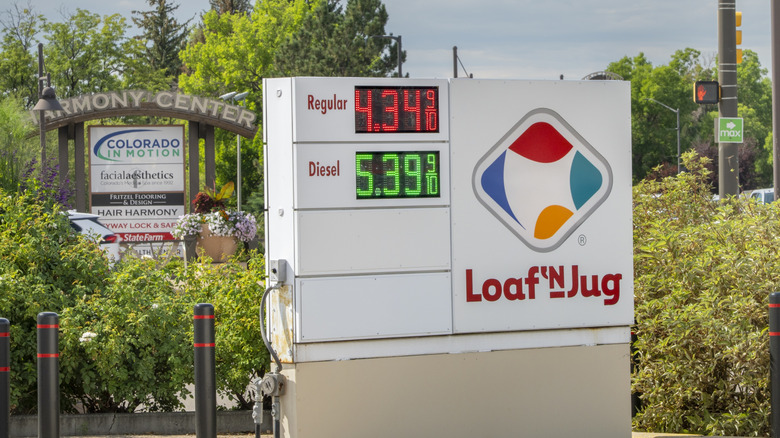
Gas is skyrocketing. Yes, electricity is going up, too, but only by about 5% year-over-year, according to the Energy Information Administration (EIA). So affording to switch to electric becomes a matter of math — which may also be helped by the fact that used EVs are rapidly heading toward gas-car price parity. As for the aforementioned rise in gas prices, it's hardly news to tell you that gas has jumped more than a dollar a gallon in a year, from $3.19 last September, when AAA was saying the U.S. was experiencing "...an abundance of crude oil supply which is outweighing demand," to today when gas has hit $4.36 a gallon — a 36.6% price increase, as of writing.
Okay, but how do you wrap your head around the price of a gallon of gas versus the price of a kilowatt, and the fueling cost to operate a gas-powered car versus an electric one? And then there's the bigger question, which is if you wanted to buy that new $36,650 Ioniq 5 versus a $32,470 Honda CR-V, what's the fueling payback time for the pricier Hyundai?
The cost-per-100-mile math is the best measure of gas vs. electric

Harazaki Ananta Hondro/Shutterstock
Let's do some dollar math. How much does it cost to drive 100 miles in an EV versus a gas car? You already know this formula for a gas car: That's just 100 miles divided by the MPG of the car in question, then multiply that by the price of a gallon of gas. On an EV, you need to look up the kilowatt-hour-per-100-mile rating of the EV you're shopping for on fueleconomy.gov, then multiply that by the kWh price where you live — the latter stands in as a kind of simulacrum for a gallon of gas.
Here's what this looks like in real life. Take that used 2023 Bolt versus the 2023 Civic, which gets a combined 35 MPG. We'll start in one of the cheapest states for buying gas, Texas. There, gas costs $3.88, according to the AAA, and electricity is also below the 18.34-cent national average at 15.94 cents per kilowatt-hour (kWh), according to the EIA.
The Honda needs 2.85 gallons to go 100 miles. Multiply this by $3.88, and you get $11.05. The Bolt's 28 kWh-per-100 miles multiplied by 15.94 cents comes out to $4.46. So in Texas, the Bolt costs less than half as much to roll the same distance. But if you live in California, where the prices for both electricity (34.74 cents per kWh) and gas ($6.04) are brutal, the math looks different. Run the same numbers for the Civic in the Golden State, and it's $17.21 to go 100 miles. The Bolt's tab runs $9.72, so it's 77% pricier to fuel the Honda. And in California, 10,000 miles later, you save $749 driving the Chevy.
EVs are cheaper to fuel, but the initial sticker still matters
Artistic Operations/Getty Images
Your gut should tell you this picture is incomplete. Your gut is correct, and we'll explain why. First, the kWh numbers from the EIA are priced at residential rates. The residential caveat matters; if you can't charge at home, EV operation gets pricier, and we'll dig into that shortly. But if you do charge at home, mapping the Bolt versus Civic again on that national-average rate of 18.34 cents and the national gas price of $4.36 a gallon, that pencils out as $12.42 for the Civic versus $5.13 for the Bolt. That gas is running 2.4 times the price of electricity.
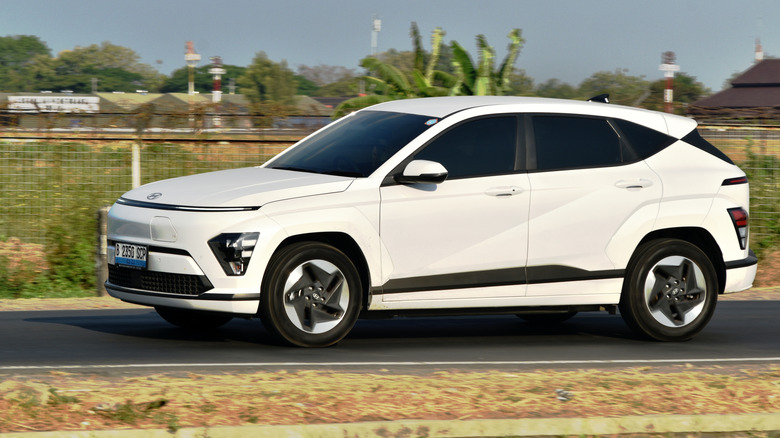
But let's also calculate using the aforementioned $36,650 Ioniq 5 against the $32,470 Honda CR-V. That's a $4,180 price premium for the Hyundai. Hitting the national average figures, the Hyundai needs 29 kWh to go 100 miles, which runs $5.31. The cheapest CR-V gets a combined 30 MPG, so that's 3.33 gallons multiplied by $4.36, which comes out to $14.51 – about 2.7 times the scratch for running the Honda, which will save you $920 in 10,000 miles.
Sadly, you're still looking at about 45,400 miles to make up the cost difference between the CR-V and the Hyundai. And we haven't even factored in the added tab on the Hyundai for monthly car payments, which are higher than ever. If gas is pricier, like in California, the payback time is a little quicker; it costs $2,011 per 10,000 miles to gas the CR-V and $1,007 to juice the Hyundai, which is a $1,004 savings over that distance. Meaning, you're in black (on the sticker difference) in about 41,600 miles.
Used EV prices are going up, but they may still depreciate faster than gas cars
Cahyadi HP/Shutterstock
Cars are depreciating assets, unless we're talking about used Ferraris. But we're not. One phenomenon worth tracking is that, until recently, used EVs were depreciating faster than used gas cars. As recently as late March, iSeeCars was showing that used EVs were losing 57.2% of their value in five years, while hybrids were losing 35.4%. That little skirmish in the Middle East has completely altered the equation, however. iSeeCars now says that used EV prices rose 7.4% year over year in June, even while used car prices overall have been off by 1.3%. In raw dollars, used EVs averaged $33,305 in June, up $2,308 from June 2025. Some of this is a bit warped; iSeeCars' math is very much buoyed by an especially quick uptick in the prices of used Teslas, where models like the used Model 3 are up 13.5%, or $3,388 in just a year.
Used Bolts are still cheap, and iSeeCars says that the car depreciates 37% in five years, which is faster than the 30.5% for the Civic. This picture won't hold forever, since demand can't go up for an asset while its value declines. iSeeCars now indicates that recent interest in used EVs will eventually push up their residuals, noting that "Shoppers waiting for low-cost used electric vehicles should no longer assume the category is getting cheaper."
The cost of gas and the cost of charging are the biggest variables you need to weigh
Ogulcan Aksoy/Getty Images
With the Iran war gas pinch, the Chinese and Europeans are becoming EV-first buyers. According to research by the firm Tradingpedia, 69.5% of new European car purchases this year were either a hybrid or EV, . The U.S. is at 27%. But in the U.S., a great deal depends not just on gas prices, but electricity rates and where you charge. Kelley Blue Book (KBB) recently charted the price to recharge that same Ioniq 5 from 10-80% at home using the national average of 18.34 cents per kWh against DC fast charging at 55 cents per kWh, which is on par with the average public fast charging rates seen from the likes of Walmart, Costco, and more brands that have the best EV charging deals. The difference is stark: $10.78 at home vs. $32.35 in public.
KBB says that the Hyundai Ioniq 6 could reach 254 miles on that 80% charge, so going back to that Honda CR-V, driving that same distance requires 8.46 gallons. Multiply those gallons by that national average $4.36, and you get $36.88, which is barely more than the cost of publicly charging that Hyundai and makes the $4,180 premium hard to justify. One (kind of) hack is Level 2 public charging, since that typically runs more like 25 cents a kWh.
Still, no question, home charging is the killer app here, and lots of utilities provide incentives like cheaper rates for customers to charge overnight. Bottom line, buying a used Bolt — or any new or used EV that's competitively priced against its equivalent gas car is not a bad idea. At today's gas prices (and who knows about tomorrow's), this is how to make the EV payback math work.