Plans to supply Immigration and Customs Enforcement (ICE) officers with special gloves that can deliver electric shocks have alarmed experts and drawn scrutiny amid some high-profile lawsuits over their use in local correctional facilities.
In one extreme case, a 43-year-old man died after allegedly being shocked 40 times by officers with a combination of the gloves and a Taser in a county jail in Kentucky, and the man’s widow is suing authorities.
Earlier this month, the Department of Homeland Security (DHS), the parent agency of ICE, published plans to spend up to $20m (£15m) to outfit ICE officers by March of next year with the controversial gloves, which are also used in various police departments and some schools.
Civil rights advocates protest that the federal agency’s use of force during Donald Trump’s immigration crackdowns already lacks proper oversight.
ICE “is putting these [gloves] in the hands of an agency that has dropped its hiring standards, its training, its background requirements in its hiring spree”, Sarah Mehta, deputy director of government affairs in the equality division of the American Civil Liberties Union (ACLU), said.
“We’re already seeing the consequences of that in lawless and violent enforcement actions in our streets,” she told the Guardian.
“What’s really terrifying is use of them on the streets, potentially to terrify people, to create a chilling effect. But what’s also scary is what [their] uses will be where we can’t see them. We don’t know how they’re going to be used in places like Fort Bliss,”she added, referring to the largest migrant detention facility in the US, where allegations of abuse are legion. The government denies claims of any inhumane conditions.
Mehta further said of the gloves: “There are no circumstances where we think their use is appropriate.”
The device carries the brand name G.L.O.V.E., which stands for Generated Low Output Voltage Emitter, and is manufactured by Compliant Technologies, a company owned by military veterans and based in Lexington, Kentucky. The glove is known as a conductive distraction and de-escalation deviceand can only be sold to certain verified entities, such as law enforcement, corrections, security, military, and emergency medical services (EMS) personnel, and requires training. It works by delivering an electric shock when the user pushes a button on the glove and touches or grips bare skin.
In one demonstration video, a man gives a brief, light touch for approximately one second to the lower back of a prone volunteer, who jerks his body and cries out: “Ow, fuck”.
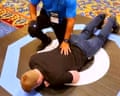
Compliant Technologies has posted multiple video demonstrations on its Instagram page. In one video from November 2025, a woman wearing the glove grips firmly on the exposed forearm of a volunteer man for about two seconds. The man buckles to the ground, shouting expletives and says “Let me go!”
“I’m going to comply any time,” the man says from the ground in a half-humorous tone to the team running the demonstration. Jeff Niklaus, founder and CEO of Compliant Technologies, can be seen laughing in the video as the man fell to the ground. “Say that louder,” he says.
The man, seemingly a prospective customer, says: “Yeah, we need that [product].”
Compliant Technologies did not respond to a series of questions and requests for comment from the Guardian.
A DHS spokesperson sent this statement in response to questions: “ICE is constantly assessing the needs of our officers in the field to ensure they have the tools and equipment necessary to safely arrest and remove criminal illegal aliens from our country.
“Every decision is made with careful consideration and appropriately reviewed to ensure that any technology ICE utilizes is consistent with all applicable law enforcement policies and standards.”
The minimum voltage for the CT-G5 model is 324 volts, and the maximum is 380 volts. A Taser, by contrast, can typically fire prongs from a distance to incapacitate someone with 1,200 to 1,500 volts.
The glove user manual instructs wearers to avoid using the product on elderly people, small children, pregnant women and disabled people.
The gloves have been deployed to a limited extent in law enforcement, healthcare, and even some educational environments across the country. An estimated 50 police departments across 20 states are using the technology, according to an NPR analysis.
In May 2025, the Omaha police department purchased 40 pairs of gloves to be used in public schools for just under $66,000, according to city documents. The department confirmed in a statement that 29 of its 34 school resource officers (SROs) – typically police providing security full time in schools – have trained in use of the gloves and work in public middle and high schools.
A representative from the Omaha police department shared with the Guardian the report from an incident where the G.L.O.V.E. was used. The report says a female SRO used the shock glove on a male middle school student based on his “highly aggressive and assaultive behavior”. The officer placed the glove on the student’s forearm twice, once for one second, and then again for two to three seconds, which, the report continued, caused the student to drop to the floor, face down.
According to the report, the SRO asked if the student needed medical assistance after being shocked, and he said no.
Last week, Omaha police acceded to a request from the school superintendent to discontinue the gloves in Omaha, Nebraska’s largest public school district, NBC reported.
In a very different example, Joshua Elswick, formerly detained at the Bullitt county jail in Shepherdsville, near Louisville, Kentucky, sued Lt Ryan Derrough alleging excessive force, after Derrough, a guard, used the gloves on Elswick during pre-trial detention.
Elswick, who has paranoid schizophrenia and other serious mental illnesses, according to the lawsuit, was arrested and booked into jail in September 2022 after a domestic dispute involving methamphetamine use. Derrough and another deputy attempted to remove Elswick’s handcuffs and leg shackles before formally taking him into custody, but Elswick was paranoid that the officers were going to kill him and he resisted, whereupon Derrough shocked Elswick with the gloves, according to the lawsuit. The incident can be seen in surveillance footage featured in a report on the case from Kentucky TV station WDRB.
The footage shows a tense scene, with the guard wearing bright yellow gloves and using them on Elswick, who is struggling against three guards, and yells out.
The Kentucky federal court dismissed Elswick’s lawsuit in June 2025, finding that Derrough’s use of force was warranted, a decision upheld by an appeals court in January.
A representative for APB Consulting Solutions, a dealer and training partner for Compliant Technologies’ product, told WDRB in 2022 that agencies undergo a lot of training and that used properly the gloves can prevent further injury – while it is recommended not to apply them for more than 15 seconds.
Sara Collins, a lawyer representing Elswick, declined to comment on the specific civil case, but told the Guardian: “With proper training and use, effective, less-lethal force options are much-needed resources in law enforcement. Shock gloves, however, are not a new tool.”
“I am troubled by the fact that the overwhelming majority of law enforcement agencies across the country do not use them,” she added, noting that relatively few departments out of 18,000 across the US have bought the gloves.
“Feasibility, practicality, training, risk of error, and intent are among my many concerns about their implementation by ICE,” Collins said.
Meanwhile, Johnathan Mansfield, who was arrested on a public intoxication charge in 2024, suffered a cardiac arrest two weeks after he was allegedly shocked 27 times with the gloves and 13 times by a Taser at Madison county detention center in Richmond, Kentucky, according to the lawsuit filed by Mansfield’s family against the authorities, claiming wrongful death.
The complaint alleges: “An internal investigation by the Madison County Detention Center found that ‘ ... Mr Manfield [sic] suffered a cardiac arrest following the series of Taser and G.L.O.V.E. exposures.’”
The internal investigation, as cited in the lawsuit, stated that “four distinct use of force incidents were recorded… resulting in a total of 13 taser exposures – comprising both probes and drive-stun applications – lasting between 23 to 28 seconds. Additionally, there were 27 exposures using the G.L.O.V.E.”
One of the shock glove exposures lasted for 45 seconds and another for 99 seconds, the document alleges.
The suit, filed in a Madison county, Kentucky circuit court, is still pending.