Canada and the United States share the longest international border in the world, along with broadly similar roads and enough cultural overlap that Americans routinely pretend Canadian television shows were ours all along. You might reasonably assume the two countries also received basically the same cars. For the most part, you'd be right. But just as you may not realize that major popular car brands build cars in Canada, every so often Canada got something genuinely interesting while the United States was left standing on the other side of the border with its face pressed against the glass.
These are some of those cars. Appearing here doesn't mean a vehicle is completely unrelated to something Americans could buy. Some shared platforms, engines, or bodywork with U.S.-market vehicles, but the specific model or body style was officially sold in Canada and not offered through American dealerships. That distinction matters because a Canadian vehicle that was not certified for the U.S. can face additional federal emissions and import requirements, even when it looks suspiciously familiar.
The lineup ranges from practical economy cars to performance wagons, Soviet off-roaders, early Korean imports, and an electric crossover that Kia announced exclusively for the Canadian market in North America. Not satisfied with universal health care, Canada also had to get the better hatchbacks and some other cool stuff to boot. Join us for a tour.
Kia EV5
We speculated that the Kia EV5 concept was a baby EV9 destined only for China, and it looks like we should get at least partial credit. It's now available in the real world, assuming you agree that Canada counts as the real world, and, as expected, it's a compact electric SUV that's exclusive to the Canadian market within North America. Canadian shoppers get a smaller counterpart to the three-row EV9, while Americans are invited to admire it online and reflect upon whatever we did to deserve this. (Was it that we let Burger King ruin Tim Hortons? Because that's fair.)
The family resemblance is not accidental. On the outside, the EV5 takes styling cues from the flagship EV9. Inside, the five-seat crossover has nearly 30 inches of combined display space, a column-mounted shifter, a front trunk, and rear seats that fold flat. Canadian buyers can choose between two battery options and front- or all-wheel drive. It's a straightforward family crossover rather than some peculiar regional experiment, which makes its absence from American dealerships all the more noticeable. Americans already buy compact crossovers by the metric ton, but apparently we aren't to be trusted with this particular one.
Nissan Micra
Before the Nissan Micra became a restyled Renault 5 with an adorable face, it was a Canadian-market oddity unveiled at the 2014 Montreal Auto Show. The U.S. remained excluded from the hot new Micra, with Nissan confirming that it had no plans to sell the Micra south of the Canadian border. That was not simply a matter of forgetting to print prices in American dollars. Nissan had not designed the Micra to meet the safety and other regulatory standards required for sale in the U.S., leaving Canadian buyers with exclusive access to Nissan's smallest hatchback. Apparently the Versa was considered sufficient punishment.
Canada's Micra was not merely a European-market car dropped into a snowbank. Nissan fitted it with a 1.6-liter four-cylinder engine, a standard five-speed manual or optional four-speed automatic, heated mirrors, rear heater ducts, and split-folding rear seats. Its real trick, though, was price: the base model launched at C$9,998, which Nissan described as the lowest starting price for a new car in Canada. Nissan even turned it into the basis of an affordable Canadian one-make racing series launched in 2015. It was basic transportation in the most literal and useful sense, a tiny five-door hatchback that made a persuasive case for owning less car. Naturally, Americans were denied the opportunity.
Acura CSX
The Acura CSX was what happened when Honda looked at the Civic, looked at Canada's appetite for small cars, and decided the obvious next step was to make one wear a nicer suit. Introduced for 2006, the CSX was developed specifically for the Canadian market and built at Honda of Canada's manufacturing facility in Alliston, Ontario. Americans could still buy a Civic, but not this particular combination of Acura badge, Canadian-market positioning, and more upscale equipment. It was essentially the answer to a question nobody in the U.S. was permitted to ask: What if my Civic grew up a little and had somewhere moderately important to be?
The standard CSX paired a 155-horsepower, 2.0-liter four-cylinder engine with either a five-speed manual or five-speed automatic transmission. It also offered Acura-grade touches including available leather seating, heated front seats, high-intensity-discharge headlights, automatic climate control, and a bilingual navigation system, because even the dashboard understood it lived in Canada. The later Type-S pushed the concept closer to a luxury Civic Si, with a 197-horsepower 2.0-liter engine, close-ratio six-speed manual transmission, and helical limited-slip differential. The CSX was not radically different from the Honda sold next door, but that is precisely what makes it interesting: Canada received a distinct entry-level Acura while U.S. buyers had to choose between an ordinary Civic and spending considerably more. Must be nice, eh?
Chevrolet Orlando
Sue Thatcher/Shutterstock
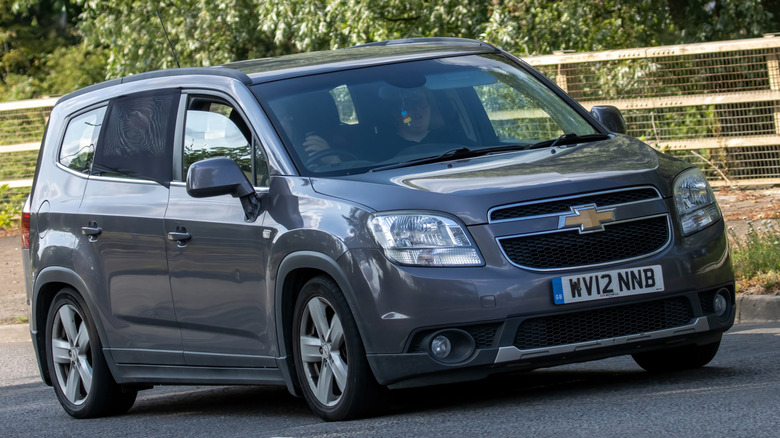
The Chevrolet Orlando didn't make the cut when we asked for your favorite cars named after places, but maybe that's because nobody's ever heard of it. The Orlando was a Canadian market Chevy that came tantalizingly close to becoming an American one before Chevy canceled U.S. plans for the weird-looking thing in 2010. GM apparently decided its American lineup already had enough family vehicles, leaving Canadians to discover what happened when the company stretched the Cruze's bones into something that could seat seven. We've since found more elegant ways to pull off three-row seating, but at the time the Orlando's tall roof and squared-off shape made it look like a minivan that lost its sliding door budget very late in the design process.
Aesthetics aside, Canadian buyers received a surprisingly useful package. The Orlando not only seated seven, but boasted a 174-horsepower, 2.4-liter four-cylinder engine with a six-speed manual or available six-speed automatic transmission. With the rear seats folded, it provided 56.3 cubic feet of cargo space, giving it genuine family-hauling ability without the footprint of a full-size crossover. None of this was glamorous, but that was the appeal. The Orlando was a practical, relatively compact Chevrolet with room for seven — precisely the kind of sensible oddball Americans often claim to want right up until an automaker asks them to actually buy one.
Volkswagen City Golf
The Volkswagen City Golf requires a little precision because Americans were hardly deprived of the Golf itself. The fourth-generation Golf had already been sold in the U.S., and the fifth-generation model arrived here for 2006 wearing the Rabbit name. What Americans did not get was the City Golf, a Canadian-market budget model that retained the fourth-generation body while borrowing some visual cues from the newer car. Volkswagen introduced it for the 2007 model year alongside the City Jetta, essentially keeping the old machinery around as a cheaper companion to the newer Rabbit. It was less a forbidden exotic than a factory-authorized automotive rerun.
Volkswagen leaned into the value pitch with almost aggressive enthusiasm. The 2007 City Golf started at C$14,900 with a five-speed manual transmission and used a 115-horsepower, 2.0-liter four-cylinder engine. Steel wheels, cloth upholstery, and manually operated windows came standard, while air conditioning, power windows and locks, heated front seats, and alloy wheels were optional or package equipment. The model continued through 2010, by which point it was called the Golf City and was still offered in Canada while Volkswagen's U.S. lineup had moved on to the sixth-generation Golf. Canada did not get a Golf Americans had never seen. It got permission to keep buying the old one after Volkswagen had moved on, which somehow feels even more Canadian.
Nissan X-Trail
Before the Nissan Rogue became the most crossover crossover to ever crossover, the Japanese automaker had another compact SUV roaming around just across the border. The company introduced the X-Trail to Canada for the 2005 model year, but declined to offer it through U.S. dealerships. It was a relatively compact, upright alternative to the more rugged-looking Xterra, with the sort of squared-off profile that we might generously say could be confused with a modern Lexus SUV.
The Canadian X-Trail used a 165-horsepower, 2.5-liter four-cylinder engine producing 170 pound-feet of torque. Nissan offered front-wheel drive or its selectable All-Mode four-wheel-drive system, along with a five-speed manual or four-speed automatic transmission. Nissan positioned it as the entry-level SUV in its Canadian lineup, below the Xterra and Pathfinder. Interestingly, it won a bunch of region-specific awards, you know, in the regions where the thing was actually sold. Europe, a bunch of Persian Gulf countries, and Mexico all seemed to like it quite a lot, just to name a few. It was practical, compact, and impressively free of drama. Naturally, Americans had to make do without it.
Mercedes-AMG C43 Wagon
Mercedes has graciously remained willing to sell fast wagons in the U.S., but apparently the compact version was asking too much. You can, of course, buy a Mercedes-AMG C43, but the shortest distance between an American and the wagon version is likely a trip north of the border, where buyers received the same basic formula as the C43 sedan with additional cargo room and a much stronger ability to make strangers at Cars and Coffee ask irritating import questions. This was not merely a C-Class wagon with aggressive bumpers and an AMG badge attached. The updated model's twin-turbocharged 3.0-liter V6 produced 385 horsepower and 384 pound-feet of torque, enough to send the wagon from zero to 60 in less than 5 seconds. It's legit, is what we're saying.
The C43 Wagon also had the hardware to be more than a very hurried grocery cart. Its nine-speed automatic transmission and rear-biased AMG Performance 4MATIC system with spirited rear-wheel bias worked alongside adaptive dampers and selectable driving modes, letting it alternate between family duty and back-road foolishness. So Canadians got a small AMG wagon capable of carrying people, luggage, and bad intentions. Americans got the sedan and a lesson in managing disappointment.
Hyundai Pony
Hyundai surprised everyone with a shockingly cool EV conversion of an old Hyundai Pony, but the reveal could have slapped a bit harder stateside. So let's rewind to before Hyundai became a company that could build a 641-horsepower electric SUV just to prove a point and was instead hard at work convincing the northernmost North Americans to buy something called a Pony. The Pony was Hyundai's first independently developed model, styled by Giorgetto Giugiaro and assembled with engineering help from British auto-industry veterans and Mitsubishi-sourced mechanical bits. The version that reached Canada was actually the facelifted Pony II, which Hyundai began exporting there in 1983. Thus the Pony became the first Korean car exported to North America, while Americans remained Ponyless because it could not meet U.S. emissions standards. Canada welcomed it.
The Pony was cheap, boxy, rear-wheel drive, and mechanically closer to a 1970s economy car than the increasingly sophisticated Japanese imports surrounding it. None of that stopped Canadians from buying it in startling numbers. Prices started at C$5,900, and roughly 45,000 were sold during 1984 and 1985. Rust and durability problems eventually damaged its reputation, but the humble Pony established Hyundai's first North American foothold years before the Excel reached the U.S. Canada did not merely receive an odd little hatchback that Americans missed. It got the opening chapter of Hyundai in North America, which would later become one of the automotive industry's more unexpected glow-ups.
Toyota Echo Hatchback
No, not that Toyota Echo. Americans are familiar with the name, but only in the form of the tall, narrow sedan that looked like it had been startled halfway through the design process — the one Jalopnik readers consider to be among the worst cars Toyota ever built. Regardless, Canada got the better implementation. Toyota unveiled the Echo Hatchback at the 2003 Canadian International Auto Show, offering Canadian buyers something akin to the European-market Yaris in three- and five-door form while the hatch remained unavailable in the U.S. Contemporary Canadian coverage called it an "only-in-Canada" model, which feels like a fairly aggressive boast for a tiny economy car. In this case, though, it was deserved.
The Echo Hatchback was short, upright, and far more useful-looking than its sedan sibling. Toyota offered it in CE, LE, and sporty-looking RS configurations, with prices beginning at C$12,995 for the basic three-door model. Every version used a 1.5-liter four-cylinder engine with front-wheel drive and a choice of five-speed manual or four-speed automatic transmission. It was not fast, luxurious, or even especially dignified, but it packaged Toyota economy-car simplicity into the body style that made the most sense. Americans eventually received a Yaris hatchback for 2007, but Canada got to spend several years enjoying the preview.
Pontiac Firefly
The Pontiac Firefly sounds like it should have been a tiny rear-wheel-drive sports car with pop-up headlights and a deeply unsafe turbo kit. Instead, it was the Canadian-market Pontiac member of the Suzuki Cultus family, whose U.S.-market relatives included the Chevrolet Sprint, Geo Metro, and Suzuki Swift. Canada received the Firefly name, while U.S. Pontiac dealerships never offered it. This was not a case of Canada getting radically different machinery. It got a familiar economy car wearing an unfamiliar badge and a name considerably more exciting than the vehicle underneath it.
The Firefly returned in several body styles and remained part of the Canadian market into the early 2000s, while the related Metro handled the same basic job in the U.S. That makes it one of the clearest examples of how General Motors once treated the Canadian market as an alternate automotive universe where familiar products could receive completely different identities. Americans may have received essentially the same little hatchback, but only Canadians could tell people with a straight face that they drove a Pontiac Firefly.
Lada Niva
Supergenijalac/Getty Images
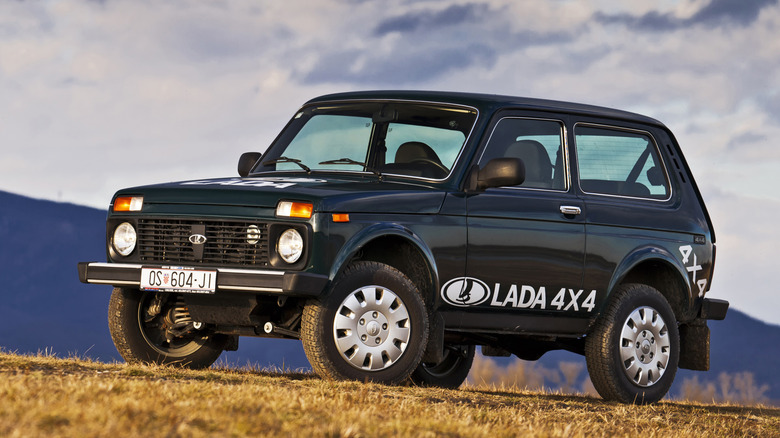
Let's end with something properly foreign. The Soviet-built Lada Niva was officially imported into Canada but never sold new in the U.S. Introduced in 1977, the VAZ-2121 was the first vehicle its manufacturer developed independently of an existing Fiat design. It combined a modest footprint, four-wheel drive, a 1.6-liter four-cylinder engine, seating for five, and genuine off-road capability. In other words, it looked prepared to cross Siberia because it was not merely dressing for the part.
Canadian buyers could find the Niva in showrooms during the 1980s, while its basic, boxy design continued for decades without the sort of complete redesign most vehicles receive. That longevity turned a small Soviet utility vehicle into an internationally recognizable automotive survivor. It also gives us an appropriately strange place to close. The U.S. had plenty of capable SUVs, imported economy cars, and automotive curiosities of its own. Still, a Lada is a Lada, and it's a cult icon among enthusiasts by any standard. It may not have been sold here new, but Canada remains something of a frosty nature preserve for the Lada Niva that refuses to die.